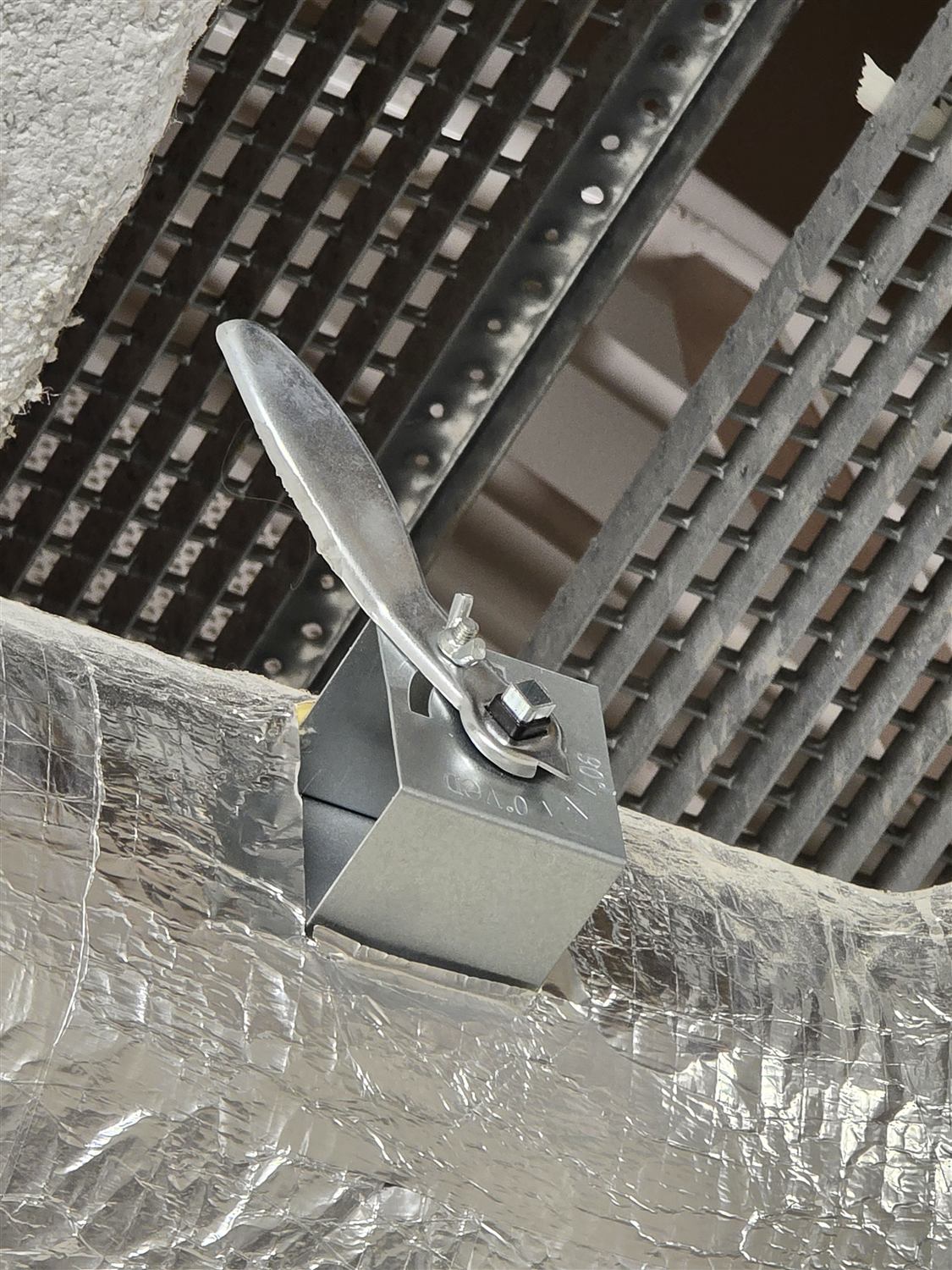
A ventilation or water network can be perfectly sized on paper : in reality, air and water take the easiest path, not the one you planned. The result : some zones get too much, others not enough. Balancing means tuning the network so that each terminal receives its design flow — no more, no less. It's one of the most cost-effective steps of HVAC commissioning.
Air, water : two networks, one principle
Air balancing distributes airflows (AHUs, ventilation, extractors, grilles and diffusers) : you measure the flow at each outlet and act on dampers and control devices. Hydronic balancing distributes water flows (chilled- and hot-water networks, fan-coils, radiators) using balancing valves. In both cases the goal is the same : deliver the right flow to the right place.
What happens without balancing
An unbalanced network doesn't break down — it works badly, silently :
- zones too hot or too cold, recurring comfort complaints ;
- some rooms over-ventilated (waste) while others starve for air ;
- noise at outlets where air velocity is too high ;
- pumps and fans pushed to the max to compensate, so higher consumption ;
- controls and the BMS that never manage to stabilise temperatures.
Check a duct air velocity
Air velocity in a duct follows from the airflow and the cross-section : velocity = airflow ÷ section. Too high a velocity creates noise and pressure losses (so consumption) ; too low, it points to oversized ducts. Try it :
Indicative design references for commercial buildings : distribution ducts ≈ 3 to 6 m/s, grilles and diffusers ≈ 1.5 to 3 m/s. Above ~6 m/s, watch noise and pressure losses. Target values depend on the project and its acoustic requirements.
Why balancing saves energy
Once the network is balanced, you remove the over-flows and can lower pump and fan speeds. These machines follow the fan/pump affinity laws : the power drawn varies as the cube of the flow.
👉 In practice : cutting a fan's flow by just 20% lowers its power draw by about 50% (0.8³ ≈ 0.51). Removing useless over-flows means immediate electrical savings — on top of the comfort.
How it's done
Balancing is a methodical measure-and-adjust process :
- flow readings at each outlet / terminal (anemometer, flow hood, flow meter) ;
- adjusting the devices (dampers, static or dynamic balancing valves) ;
- proportional method to spread the corrections without upsetting what's already set ;
- pressure measurements at the end of the network ;
- a balancing report documenting the flows achieved.
🌬️ At Clim Froid Services, balancing is at the heart of what we do : air balancing (per-diffuser measurements), hydronic balancing (chilled / hot water), end-of-network pressure measurements and supporting reports. Have your installation balanced.
Going further
- Fan and pump affinity laws : flow ∝ speed, pressure ∝ speed², power ∝ speed³ (HVAC engineering principle).
- Continuity relation : airflow = velocity × section (Q = V × A).
- Target velocities are a matter of good practice and the acoustic requirements of each project ; the references given here are indicative.