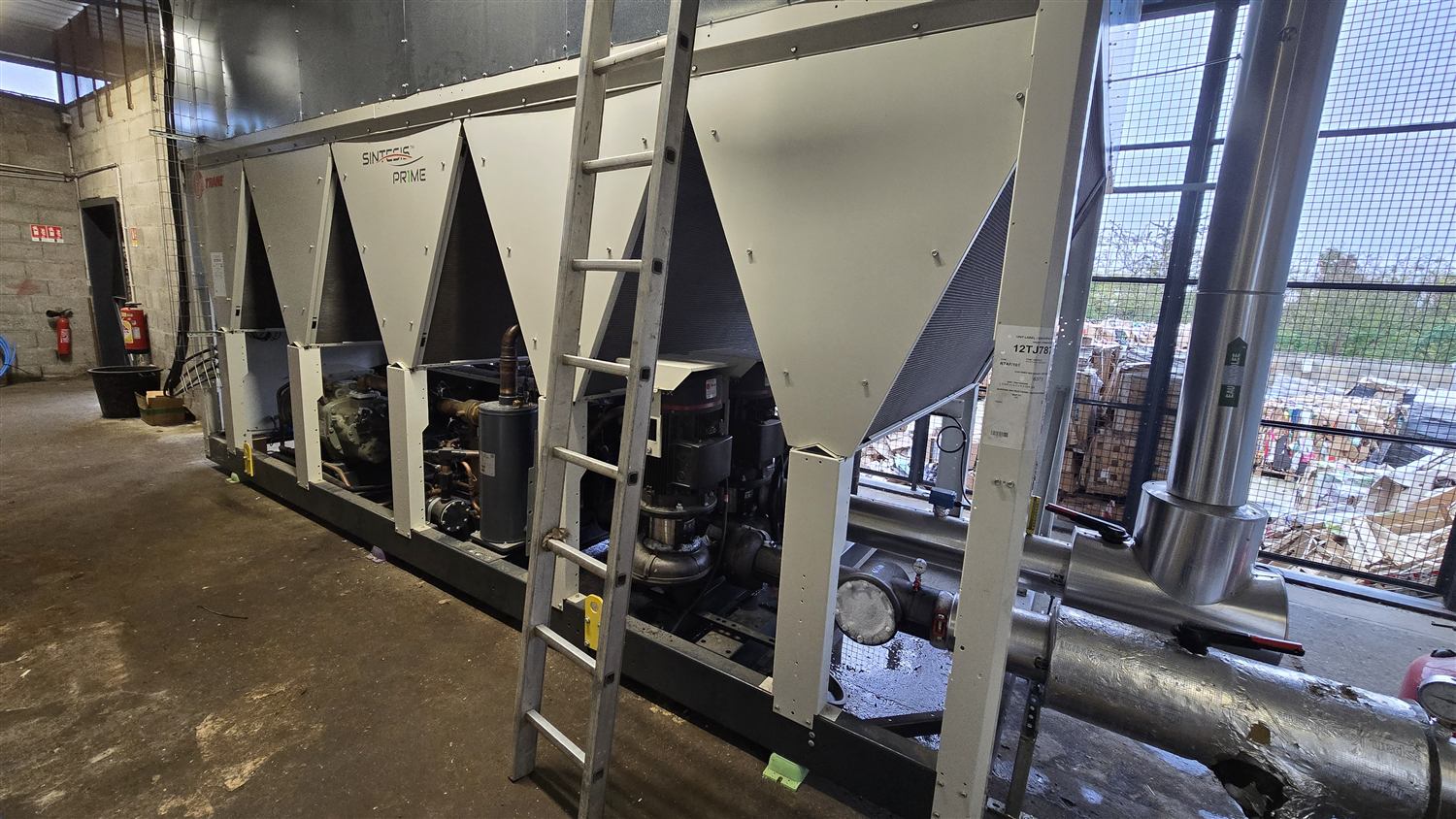
A leaking refrigerant makes no noise, can't be seen, and triggers no alarm. Yet a few kilos are enough to emit several tonnes of CO₂. The reason : these gases have a warming power hundreds to thousands of times greater than carbon dioxide. Here is how to measure it — and why leak detection is one of the most effective actions for the climate.
GWP — the key to everything
GWP (Global Warming Potential) measures a gas's greenhouse effect compared to CO₂ over 100 years. CO₂ has a GWP of 1, by definition. A refrigerant such as R410A has a GWP of 2,088 : releasing 1 kg of R410A is therefore equivalent to releasing 2,088 kg of CO₂.
The calculation is simple : kg of refrigerant × GWP = kg of CO₂ equivalent. Try it with your installation :
100-year GWP per the IPCC (AR4), the reference values of the EU F-Gas Regulation. The current Regulation (EU) 2024/573 uses AR5 values, slightly lower (e.g. R410A : 1,924) — the order of magnitude is unchanged. Indicative comparisons : petrol car ≈ 120 g CO₂/km · 1 tree ≈ 25 kg CO₂/year · 1 round trip Paris–New York by plane ≈ 1.7 t CO₂/passenger.
What it means in practice
Take a common case : an office air-conditioning system charged with 5 kg of R410A that leaks entirely. That's 10,440 kg of CO₂, equivalent to :
And that's a single installation. Across a fleet of multiple units, undetected diffuse leaks represent a major — and invisible — climate impact.
Not all refrigerants are equal
The gap between older refrigerants and the newer generations is huge. Replacing an R404A (GWP 3,922) with a low-GWP solution divides the impact of a leak by hundreds, even thousands.
- High GWP, replace as a priority : R404A (3,922), R410A (2,088).
- Intermediate generation : R407C (1,774), R134a (1,430).
- Low GWP : R32 (675), R454B (466).
- Natural refrigerants : R290 / propane (3), R744 / CO₂ (1), R717 / ammonia (0).
A regulatory stake : F-Gas
The EU F-Gas Regulation organises the gradual reduction (the "phase-down") of high-GWP refrigerants : falling quotas, targeted bans, mandatory leak checks and record-keeping for equipment above certain thresholds. In practice, R404A and R410A installations are expected to be kept leak-tight, retrofitted or replaced.
🔧 At Clim Froid Services, we carry out leak-tightness checks, leak detection, maintenance and retrofitting of your refrigeration systems towards low-GWP refrigerants. Fewer leaks, less CO₂, and F-Gas compliance. Have your installation audited.
Sources
- Regulation (EU) 2024/573 on fluorinated greenhouse gases (F-Gas), which repealed Regulation (EU) No 517/2014 — eur-lex.europa.eu. The GWP values shown here are from the IPCC Fourth Assessment Report (AR4); the current regulation now uses AR5.
- IPCC, Fourth Assessment Report (AR4) — 100-year global warming potentials.
- ADEME — emission factors (road, air transport) and forest carbon sink — base-empreinte.ademe.fr
Comparisons are orders of magnitude for educational purposes ; real factors vary with the vehicle, flight and tree species considered.